451.
Lurene's email in 2014: lurenexyz@gmail.com
Letter to Lurene from Riad Adameh of Jerusalem, May 10, 2002. It was a friendly letter, but with no content of major public interest. He mentions his family, asks about my travels, and touches on the economics of his daily life in 2002 Jerusalem.
I kept the letter simply because it seemed silly to throw it in office waste bin when I received it in San Francisco. Also, I got so few handwritten letters from Jerusalem. His English was quite good, too. His native language is Arabic. I can't right now find the nice photos I have of him, but will in the next week or so.
452.
Published news story by Lurene Kathleen Helzer, January 7, 1987, El Cerrito Journal or Hills Publications, “City reaches deeper into pockets; Insurance Costs Take Heavy Toll On Budget”.
Email Lurene in 2014 at lurenexyz@gmail.com
453.
Published news story by Lurene Kathleen Helzer, January 14, 1987, El Cerrito Journal or Hills Publications, “Council Takes Sides In The Dump Dispute”.
454.
Published news story by Lurene Kathleen Helzer, January 14, 1987, El Cerrito Journal or Hills Publications, “Acquiring Property Is Next Step Towards Schurgin Shopping Mall”. Partial clip only.
455.
Published news story by Lurene K. Helzer, July 18, 1991, El Cerrito Journal, “New EC planner trades in long commute; Ready to tackle unique needs of built-up city”. Photo by Lurene Helzer runs with caption, “Mark Coughey works and lives in the same city, a great situation for bicycle commuting.”
Check out my other blogs and donate your $10 today at link below:
bayarealurene.blogspot
bayarealureneb.blogspot
fecklesspreapproved.blogspot
unbelievableanimalstories.blogspot
baghdadiproposal.blogspot
risksinreporting.blogspot
genesisoutline.blogspot
mobiloilnigeriaman.blogspot
northbeachman.blogspot
blackholeeconomics.blogspot
Monday, December 7, 2009

Tuesday, December 1, 2009
450. Budget in the East Bay, 1987; El Cerrito Had One Word Processor

No matter what financial problems plagued the East Bay in the late 1980s, you had baseball. Photo by Lloyd Francis.
450.
Published news story by Lurene Kathleen Helzer, El Cerrito Journal and/or Hills Publications, December 10, 1986, “1986-87 Budget Passed Finally By City Council”.
Email Lurene in 2014 at lurenexyz@gmail.com
Here is a section of the budget story. City budget stories are normally quite uninteresting, especially when more than two decades have passed; 2009 is closing as I post this little 1987 city budget story. But this story may be interesting for Californians today because it shows that those who run the state’s municipalities have been through financial crises before, and have found the paths through them. In the late 1980s, city managers and elected leaders were over and over and over again bashing California’s Proposition 13. It’s all we heard each night on local news shows as residents of the state – believe me!
But this small section gives some insight into attitudes and problems some Northern California local leaders adopted and faced through the difficulties:
“If we are going to continue the services we have with the city, we’re going to have to continue to revitalize” said El Cerrito council member and former mayor, Charles R. Lewis.
“I think most of the sophisticated developers in town will understand that the city is not an impediment to development…we’re not trying to come in with a bunch of restrictions like: ‘you can’t build this, you can build that,’” said Lewis.
“We are in the development business hand in hand with the developers.”
Cutbacks in city services were made in earlier years when, after the passage of Prop 13, the Council had to reduce allocations for street and park maintenance and eliminate some jobs. Now the Council is rebuilding what was lost or deferred during those years, Council members say.
A study initiated by the Council revealed that the City’s pension program was severely underfunded, Lewis said. Commenting on that study, he said the finding that the program was some two million dollars underfunded “shocked everyone.”
The results of a wage classification study found El Cerrito employees in some cases earning 28 percent less than their counterparts in other cities of comparable size, according to council member and mayor pro tempore, Anna G. Howe.
“The city’s limitations are still rather strong but were not laying off people,” said Howe. “We’re staying within the taxes that are allocated to us. We are adopting a very responsible and conservative fiscal line. We’re working for a government that has limits, but that works well within that limit.”
Another long-term project will be the purchase of computers, Howe indicated. She described it as a project that will enable the city to increase their services and process information more efficiently.
“It’s hard to believe in a city our size we have one word processor with two terminals,” said Lewis.
Check out my other blogs and donate your $10 today at link below:
bayarealurene.blogspot
bayarealureneb.blogspot
fecklesspreapproved.blogspot
unbelievableanimalstories.blogspot
baghdadiproposal.blogspot
risksinreporting.blogspot
genesisoutline.blogspot
mobiloilnigeriaman.blogspot
northbeachman.blogspot
blackholeeconomics.blogspot
449. Project Listen in El Cerrito Debates City Finance, 1987. Photo of Lurene in 1987 New York City.

Photo of Lurene in 1987 visiting New York city. This photo, by Lloyd Francis, taken at 7 a.m. in Manhattan apartment I slept in for few nights. Was in NYC, but on way to news events elsewhere. In this pic, am watching update about Iran-Contra Hearings as they were unfolding, I am fairly sure. Smoking cigs back then, drinking coffee.
Email Lurene in 2014 at lurenexyz@gmail.com
I still drink coffee, but quit smoking, thank goodness!! I hate this photo of me because of the cig, but others always liked it.
449.
Published story by Lurene Helzer and Ocie Hudson, Hills Publications, October 18, 1990, “Project Listen works toward EC consensus”, describes effort by El Cerrito City Council to create citizen task forces to deal with its shortage of revenue. This story was published in several Hills Publications, but this version reminds me that my old roommate, Ocie Hudson, a man originally from Texas, assisted me in covering that city council meeting in El Cerrito.
I remember Ocie, normally an East Bay computer-geek before that term was fashionable, being enthusiastic about helping with this story. He did a great job, and got along well with people at the meeting. He needed no help in public relations because he was a fine communicator. I do not remember, however, why he was asked by us to assist with the story. I have a photo of Ocie Hudson somewhere in my collection, and want to find it to post it here.
Check out my other blogs and donate your $10 today at link below:
bayarealurene.blogspot
bayarealureneb.blogspot
fecklesspreapproved.blogspot
unbelievableanimalstories.blogspot
baghdadiproposal.blogspot
risksinreporting.blogspot
genesisoutline.blogspot
mobiloilnigeriaman.blogspot
northbeachman.blogspot
blackholeeconomics.blogspot
Monday, November 30, 2009
448. San Francisco's East Bay During Last Years of Cold War, Ronald Reagan, Etc.

1987 political cartoon by Jefferds for El Cerrito Journal satirizing U.S. President Ronald Reagan's policies, including his administration's positions on Iran and the Soviet Union.
448.
Published news stories for various East Bay newspapers by Lurene Kathleen Helzer:
El Cerrito Journal, December 10, 1986, “Police Report; Robbers Still Hitting San Pablo Stores”;
El Cerrito Journal, June 11, 1987, “Office Proposal Confuses Fate Of Kearney Street”;
El Cerrito Journal, June 11, 1987, “Women’s Center Facing Order Of Condemnation”;
El Cerrito Journal, January 14, 1987, “State of the City Address: Mayor Views City Growth With Boundless Optimism”. Mayor of El Cerrito then was H. Richard Mank;
El Cerrito Journal, January 7, 1987, “Year-end council action; Citizens Rally Too Little Too late Against Schurgin Project”. Photos of Norma Simmons and Patrick O’Keeffe by Lloyd Francis. Cartoon by Jefferds on page 2 depicts U.S. President Ronald Reagan as quarterback with football team, shirts on players say “New Congress”, “Debt”, Iran”, “U.S./U.S.S.R. Relations”, “Surgery”, with Reagan saying ‘Follow me team. Just one more for the Gipper!’”;
El Cerrito Journal, November 8, 1990, “EC council sets a limit on home childcare center”;
Check out my other blogs and donate your $10 today at link below:
bayarealurene.blogspot
bayarealureneb.blogspot
fecklesspreapproved.blogspot
unbelievableanimalstories.blogspot
baghdadiproposal.blogspot
risksinreporting.blogspot
genesisoutline.blogspot
mobiloilnigeriaman.blogspot
northbeachman.blogspot
blackholeeconomics.blogspot
447. EL CERRITO'S 1991 FINANCES, REPAIRS, BASIC SERVICES. REAGAN WAS THE MAN WITH THE KEYS TO CITY BUDGETS, 1991 PEOPLE STILL CLAIMED

Photo of Ronald Reagan from Stock Free Photos.
447.
Published news story for El Berkeley Voice by Lurene K. Helzer, January 2, 1991, “City can’t meet budget with current income; Basic services and repairs may take new taxes, bonds”. Runs with series the paper was doing in 1991 titled “East Bay ’91; What’s to come? A special issue.”
This article ran in other East Bay newspapers printed by Hills Publications in 1991, The El Cerrito Journal, for one, on a different date. Part of article below:
Jean Siri, El Cerrito City Council.
Journal – Is the anti-tax feeling that gripped California through the Proposition 13 years and Gov. George Deukmejian years still going strong?
Siri – Well, I like to think that it isn’t because people can see that the streets are wearing out, the trees are not being trimmed, the parks are falling apart and the buildings are falling apart. People must realize you can’t get something for nothing.
Journal – Did people actually get so unrealistic throughout the last decade that they thought there was a free lunch?
Siri – Well, Reagan convinced everybody there was – that it’s stylish to be greedy. He made it stylish to get what you could get for yourself and hang on for dear life and not pay any taxes. People wanted to believe what he was saying and I suppose they did.
Journal – Did a lot of this attitude creep down to El Cerrito?
Siri – Oh, sure.
Journal – Is it still there?
Siri – I don’t know. I’m certainly hoping not. I hope by calling people in and telling them what our problems are…I was appalled before, but now that I’ve listened to the problems that I didn’t even know we had in the facilities committee, I don’t know what we’re going to do. I thought the safety building was in good shape and it turns out that it’s just a mess. You can’t defer maintenance for very long and get by with it.
My theory is we can’t possibly do all the things that need to be done even if we can get people to pass a bond issue. We’re going to have to do it gradually because we’re so far behind.
Journal – Are we in a situation now where, no matter what we do, something else should have been done first – a vicious circle?
Siri – Well, I think our city hall facility at the moment looks awful, but it works. We can live with that for another five years if we have to – 10 maybe if we had to. But I don’t think we can live with the fire and safety (building) situation any longer. I don’t even think we can live with the storm sewers any longer, because the lawsuits against the city are getting so big. We’ve always been cutting and deferring, cutting and deferring. You can’t do that in your house.
Check out my other blogs. Make your $10 donation today through PayPal link below:
bayarealurene.blogspot
fecklesspreapproved.blogspot
unbelievableanimalstories.blogspot
baghdadiproposal.blogspot
risksinreporting.blogspot
genesisoutline.blogspot
mobiloilnigeriaman.blogspot
northbeachman.blogspot
blackholeeconomics.blogspot
Saturday, November 28, 2009
445, 446: EAST BAY REDEVELOPMENT ISSUES OF 1987, 1990

Redevelopment was a frequent topic of local government debates in Alameda and Contra Costa counties in the late 1980s, early 1990s. Unpublished photo of handsome construction worker taken at construction site in downtown Oakland, CA by Lurene, probably around 1986. I did not know this man, but was walking to BART 12th St. station with camera in hand, quickly snapped shot.
445, 446:
Published news story for El Cerrito Journal by Lurene Kathleen Helzer, May 13, 1987, “Delays in Schurgin Project Anger Proposed Tenants.” Photos of residents at meeting alongside story also by Lurene Helzer.
This story gives detail about how difficult it was to get an aged trailer park out of El Cerrito’s main commercial area to make room for the development of a retail development which could bring more tax revenue to the city. This story available if requested.
Next, published news story for El Cerrito Journal by Lurene K. Helzer, October 4, 1990, “Target Store plan ok’d; Approval comes over objections”. Original story follows, providing some detail about El Cerrito as it was in the late 1980s, early 1990s:
EL CERRITO – Over the objections of some agency members, the redevelopment agency will enter into an agreement with the Target Stores retail discount chain for the construction of a new El Cerrito store.
Community Development Manager Pat O’Keeffe called the deal a “sure thing” in his report Monday to the City Council, which passed resolutions authorizing the agreement.
Councilmember Cathie Kosel, voting against the resolutions along with El Cerrito Mayor Robert Bacon, commented that the city “could have cut a better deal.”
The city and redevelopment agency will receive $283,000 yearly in revenues from sales and property taxes, according to staff estimates.
The store is to be built on San Pablo Ave. between Hill and Blake streets, which will displace residents of a trailer court and require the relocation of a bowling alley.
American Recreation Centers District Manager Fred Foerster, speaking for Golden Gate Lanes in El Cerrito, spoke before the council, visibly frustrated. “We are not interested in moving north of our present location. We’d like to stay.”
Also opposed to the agreement was El Cerrito Elms Trailer Park resident Laureen Burnett, who brought her two-year-old baby up to the podium in front of the council as she spoke.
“We’re living on edge…day by day. I just wish the matter would be taken care of,” said Burnett, complaining about the uncertainty of the relocation process.
Burnett, who was accompanied to the council meeting by her father and husband, also complained that the agency was unclear in explaining what, if any, relocation benefits she and her family would receive.
O’Keeffe seemed sympathetic to complaints brought before the council, and said relocations were ‘the most agonizing part of the redevelopment process.”
He promised to deliver a “definite relocation schedule” as soon as he could, while noting that he had unsuccessfully tried to keep in touch with the parties by telephone.
The proposed agreement calls on Target Stores to pay for $3.5 million of the total $6.5 million cost of relocation and acquisition. The agency will carry the remaining $3 million, borrowing $750,000 of that from Target Stores.
The $750,000 loan to the agency will be repaid at a 9 percent annual interest rate. The repayments themselves are to come from tax increments generated from the store over 12 years. According to staff estimates, this makes the agency responsible for a total interest payment of $1,158,867 over the 12-year period.
“I’m concerned that there’s a 12-year payback. If Target wants to be here, they should put the money up,” said Councilmember Cathie Kosel.
O’Keeffe cited the attractive revenues anticipated from the store. “Given the difficulty of balancing the budget, it’s a good deal,” he said.
“Usually, we try to stay within a 10-year period, but this is a sure thing,” O’Keeffe said in response to Kosel’s concerns. – end –
Check out my other blogs. Make your $10 donation today through PayPal link below:
bayarealurene.blogspot
fecklesspreapproved.blogspot
unbelievableanimalstories.blogspot
baghdadiproposal.blogspot
risksinreporting.blogspot
genesisoutline.blogspot
mobiloilnigeriaman.blogspot
northbeachman.blogspot
blackholeeconomics.blogspot
Tuesday, November 24, 2009
164. Kohl Visits 1991 UC Berkeley after Fall of Nightmare, Communist Europe


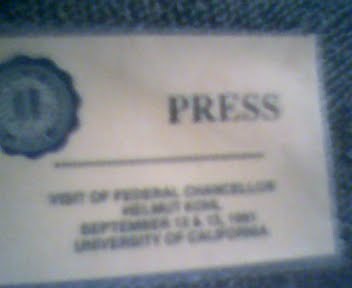
Occupied Berlin during Cold War, photo from Wikipedia site; Old Soviet prison cell, photo date and location unknown, from Travelblog website; Soviet Vice Consul Germandy German in office at former Soviet Consulate in San Francisco, Green Street, 1984, photo was for interview we did for student newspaper, I wrote story, photo by journalism student Howard Ford; Berlin Wall shortly after completion in 1962, photo found in Truman Library Collection website; Press pass for September 12 and 13, 1991 to attend post-Cold War speech by German Chancellor Helmut Kohl at UC Berkeley's Greek Theater.
164.
Published news story for The Berkeley Voice by Lurene K. Helzer, September 19, 1991. Headlined Chancellor Kohl speaks on campus. Runs with photo of German Chancellor Helmut Kohl, who was speaking at UC Berkeley’s Greek Theater before some 7,000 people, mostly students. [The Berkeley Voice is different than The Berkeley Planet. I did work for both.]
The Soviet Union and its communist empire “collapsed” on November 9, 1989. The Berlin Wall was now a relic. Kohl had arrived to the Berkeley campus to comment on central Europe’s emerging prospects and tone for future. I think this is one of the more important stories I was given chance to cover for Berkeley papers.
The communist world had been collapsing in fits and starts, ideologically and militarily, before this 1989 date. In this 1991 Berkeley speech, Kohl was discussing the job of putting Europe together -- economically and legally – following the death of European communism. Between 1945 and 1990, the world could not know a whole German nation.
Notably, then, he did not speak much about World War II, or the incalculable crimes of Germany through the Nazi party and Adolf Hitler. Not on this Berkeley day. He made only some reference to that era for this speech.
Why so little talk of National Socialism, at least for the wrath and war it brought to millions?? The answer was this: Europe’s immense problems in 1991.
In 1991, Europe, Russia, and the United States were completely overwhelmed with recovering their civilizations from the long, Cold War. Confusion was everywhere, mixed with an alien excitement in most of the world.
Nobody objected to his chosen topics because people in Berkeley wanted almost exclusively to hear his remarks about the fall of Moscow and the complete failure, and end, of dictatorial communism.
Most of us at Berkeley that day had spent our entire lives thinking we’d never hear such a speech, certainly not from an economically cautious German leader.
Kohl had more in common with Ronald Reagan than many today realize. The German left was frequently opposed to Kohl’s policies.
It’s difficult to overemphasize the preoccupation of the young crowd that day in Berkeley with the fall of communism in Europe. Here you had students who’d grown up not with a real knowledge of fascism, but with a legitimate fear of nuclear annihilation.
By 1991, we did not quite know what National Socialism meant in real life. Leftist rhetoric aside, we never really had to work with its crude smell over an entire continent. It’s almost completely impossible to understand it if you’re an average American of 2008. I almost never trust the modern American’s use of the word fascism, or the motives of the speaker.
The Czech Republic had yet to be declared or recognized, but it was already letting the tip of its nose show. In fact, Kohl makes reference to communist Prague of 1968 in a provocative way during this speech.
Surprisingly, you find little record of Kohl’s speech on the internet today. You can find a little about his visit to Berkeley in 1991 through the U.S. State Department, through UC Berkeley or through other such sources, but you will get little detail. So, the exact words of his speech are not easily found today. I almost sigh in relief that I found this story I wrote for the Voice to place here today.
Summing up: Germany’s leader said Germany alone could not repair the damage of the Cold War. He also discussed the emerging new shape of Europe. Kohl did not predict the rise of extremist Islam yet, of course. Few outside the Mideast quite were in 1991, which is quite clear in 1991 story below:
Germany alone cannot revive the newly emerging democracies of the world, that country’s chancellor Helmut Kohl told an audience at UC Berkeley’s Greek Theater.
“We are providing 56 percent of all Western aid to the Soviet Union and 32 percent of Western assistance to the countries of Central, Eastern and South-Eastern Europe. Allow me to be very frank with you here: We have already reached the limits of our potential. Nonetheless, we shall participate in further multilateral efforts,” Kohl said.
“Europe continues to need America, but let me also add this: America needs Europe,” he added.
Calling Germany “Europe’s economic locomotive,” the 61-year-old leader of the reunified nation said “optimism and pioneering spirit would be crucial for the reconstruction of Europe.”
He also spoke on the Yugoslavian civil conflict, the disintegration of the Soviet Union and the future of the European Community.
He compared the rebuilding efforts now underway to the Marshall Plan, which was implemented in Europe by the United States following World War II.
Addressing his remarks specifically to students, who comprised most of the audience of 7,000 in the outdoor amphitheater, he said he hoped this century would end on a “happier note” by redressing the “problems of the past.” He especially urged students to learn from the bloody agonies of the 20th Century.
In his lifetime, Kohl has worked to rebuild Germany not once, but twice – after the ravages of war and now after the fall of the Communist government of the “eastern lander.”
The Berlin Wall, a symbol of the cold war for over 40 years, fell in November 1989. Kohl came up with a 10-point plan for reunification by the end of the month.
Germany reunified by a vote of the residents of East Germany on Oct. 3, 1990. The German Economic and Monetary Union was enacted by July 1 of the same year. With unification, Germany became a nation of 64.1 million people, with factories in East Germany on average one third as productive as the factories in the West.
The real problem for Germany, Kohl said, is not only to achieve economic unity, but “social and cultural unity.”
“A European political union must lay clear-cut foundations for a common foreign and security policy,” said Kohl. “My government does not want to weaken the tried and tested Atlantic alliance in any way,” he said, making a clear reference to the North Atlantic Treaty Organization (NATO).
The continued need for NATO was illustrated by the breakup of the Soviet Union and the civil strife in Yugoslavia, as well as the recent Persian Gulf war, he said.
Kohl called for all use of force in Yugoslavia to be “stopped immediately without qualification.”
“When dialogue and harmonious coexistence are no longer possible we must, in line with our understanding of the right to self-determination, consider the question of recognizing under international law those republics which no longer wish to belong to Yugoslavia,” he said.
Kohl also spoke at length on the Soviet Union. “We the Western nations must now jointly provide swift and extensive aid to the Soviet Union so that it can progress further toward democracy and a market economy,” he said.
Kohl compared the recent coup attempt to the uprising in Prague, Czechoslovakia in 1968. The Soviet coup attempt was exactly 23 years after the hopes of protestors had been crushed by tanks in Prague, Kohl said.
August 21 will “go down in history as a belated triumph for the people who had then tried to stop those tanks,” he said to enthusiastic applause.
But “despite all our delight and satisfaction at the historic victory of freedom and democracy, the motto now cannot be “business as usual.’ Not least we owe this to the men and women who risked and lost their lives during the days of that Russian ‘August Revolution’.”
He said negotiations for Hungary, Poland and Czechoslovakia’s association agreements should be completed as soon as possible as “accession to the community must also be open to those three countries, once appropriate conditions exist there. Europe includes not just Paris, London and Berlin, but also Warsaw, Prague and Budapest – and naturally Vienna and Stockholm as well.”
After the Tanner lecture, Kohl was given the Berkeley Medal, the university’s highest honor, by UC-Berkeley chancellor Dr. Chang-Lin Tien. The Tanner Lectures on Human Values, according to UC-Berkeley’s office of Public Information, is to “advance and reflect upon the scholarly and scientific learning related to human values and valuation.”
Kohl, while in Berkeley, also participated in the ceremonial debut of the Center for German and European studies on Sept. 12. The German government will contribute $870,000 each year for 10 years to the center, one of three in the United States.
end –
Check out my other blogs. Make your $10 donation today through link below:
bayarealurene.blogspot
bayarealureneb.blogspot
fecklesspreapproved.blogspot
unbelievableanimalstories.blogspot
baghdadiproposal.blogspot
risksinreporting.blogspot
genesisoutline.blogspot
fecklesspreapproved.blogspot
unbelievableanimalstories.blogspot
baghdadiproposal.blogspot
risksinreporting.blogspot
genesisoutline.blogspot
Subscribe to:
Posts (Atom)
